

Question Description
1) in general, under what conditions might a firm favor a level production plan over a chase plan? A chase production plan over a level plan?
2) The just-in-time (JIT) movement has long argued that firms should:
- Maximize their process flexibility so that ordering costs are minimal.
- Stabilize demand levels.
- Shrink lead times as much as possible.
- Assign much higher holding costs to inventory than has traditionally been the case.
Using the economic order quantity (EOQ) and reorder point (ROP) formulas, explain how such efforts would be consistent with JIT’s push for lower inventory levels
* READING MATERIAL ATTACHED BELOW FOR QUESTION 2
A major limitation of the EOQ model is that it considers the impact on costs for only a single firm. No consideration is given to how orderquantity decisions for one firm affect other members of the supply chain. Therefore, even though the EOQ minimizes costs for a particularfirm, it can cause problems for other partners and may actually increase overall supply chain costs. An example of this is the bullwhip effect.5APICS defines the bullwhip effect as “an extreme change in the supply position upstream in a supply chain generated by a small change indemand downstream in the supply chain.”6
Bullwhip effect
According to APICS, “an extreme change in the supply position upstream in a supply chain generated by a small change in demanddownstream in the supply chain.”
To illustrate, suppose the ABC plant makes pool cleaners that are sold through six distributors. The distributors have similar demand patternsand identical EOQ and ROP quantities:

Figure 11.12 shows the results of a simulation covering 50 weeks of simulated demand across the six distributors. Even though total weekly demand across the six distributors ranged from 2,331 to 3,641, the quantities ordered by the distributors to be shipped from the plant rangedfrom 0 to 7,500 in any one week.
5Hau L. Lee, V. Padmanabhan, and S. Whang, “The Bullwhip Effect in Supply Chain,” Sloan Management Review 38, no. 3 (Spring 1997): 70–77.
6Definition of Bullwhip Effect in J. H. Blackstone, ed., APICS Dictionary, 14th ed. (Chicago, IL: APICS, 2013). Reprinted by permission.
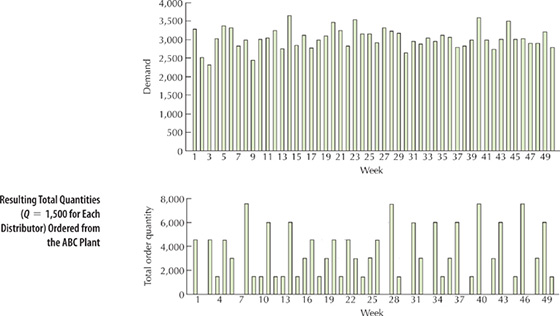
FIGURE 11.12 Total Demand across the Six Distributors
What causes this? Quite simply, if a distributor reaches its reorder point, it places a large order. Otherwise, it does nothing. Therefore, a single-unit change in demand may determine whether a distributor places an order. So even though the distributors may be following goodinventory practice by ordering in quantities of 1,500, the impact on the supply chain is to increase demand variability at the plant. Ultimately,this demand variability will drive up costs at the plant, which will then be forced to pass on at least some of these costs to the distributors.
In order to reduce the bullwhip effect, many supply chain partners are working together to reduce order quantities by removing volumediscount incentives and reducing ordering costs. Figure 11.13 shows, for example, what the quantities ordered from the plant would look likeif order quantities were cut in half, to 750. Now the orders range from 750 to 4,500; this is not perfect, but it’s a big improvement over whatthe range was before.
Inventory Positioning
Managers must decide where in the supply chain to hold inventory. In general, the decision about where to position inventory is based on twogeneral truths:
1. The cost and value of inventory increase as materials move down the supply chain.
2. The flexibility of inventory decreases as materials move down the supply chain.
That is, as materials work their way through the supply chain, they are transformed, packaged, and moved closer to their final destination. Allthese activities add both cost and value. Take breakfast cereal, for example. By the time it reaches the stores, cereal has gone through such asignificant transformation and repackaging that it appears to have little in common with the basic materials that went into it. But the valueadded goes beyond transformation and packaging; it includes location as well. A product that is in stock and available immediately is alwaysworth more to the customer than the same product available later.
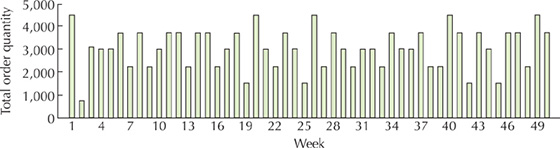
FIGURE 11.13 Resulting Total Quantities (Q = 750 for Each Distributor) Ordered from the ABCPlant
What keeps organizations from pushing inventory as far down the supply chain as possible? Cost, for one thing. By delaying thetransformation and movement of materials, organizations can postpone the related costs. Another reason for holding inventory back in thesupply chain is flexibility. Once materials have been transformed, packaged, and transported down the chain, reversing the process becomesvery difficult, if not impossible. Wheat that has been used to make a breakfast cereal cannot be changed into flour that is suitable for making acake. Likewise, repackaging shampoo into a different-sized container is impractical once it has been bottled. The same goes fortransportation: Repositioning goods from one location to another can be quite expensive, especially compared to the cost of delaying theirmovement until demand has become more certain. This loss of flexibility is a major reason materials are often held back in the supply chain.In short, supply chain managers are constantly trying to strike a balance between costs on the one hand and flexibility on the other indeciding where to position inventory.
EXAMPLE 11.9 Pooling Safety Stock at Boyer’s Department Store
An especially good case for holding back inventory can be made if an organization can hold all of its safety stock in a single centrallocation while still providing reasonably fast service to customers. This is one example of inventory pooling, in which several locationsshare safety stock inventories in order to lower overall holding costs. Suppose, for instance, that Boyer’s has eight stores in the Chicagoarea. Each store sells, on average, 10 ceiling fans a day. Suppose that the standard deviation of daily demand at each store is 3 (σd = 3) andthe average lead time from the fan manufacturer is 9 days, with a standard deviation of 2 days. We showed in Example 11.3 that tomaintain a 95% service level (z = 1.65), a store would need to maintain a safety stock of 55 fans. The total safety stock across all eightstores would therefore be 8*55 = 440 fans.
Inventory pooling
Holding safety stock in a single location instead of multiple locations. Several locations then share safety stock inventories tolower overall holding costs by reducing overall safety stock levels.
But what if Boyer’s could pool the safety stock for all eight stores at a single store, which could provide same-day service to the otherseven stores? Because a single location would have a demand variance equal to n times that of n individual stores:

For Boyer’s, this calculates out to:
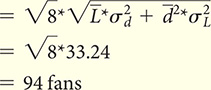
And the pooled safety stock would be:
Z*94 = 1.65*94 = 155.1, or 155 fans
By pooling its safety stock, Boyer’s could reduce the safety stock level by (440 − 155) = 285 fans, or 65%. Considering the thousands ofitems stocked in Boyer’s eight stores, centralizing Boyer’s safety stock could produce significant savings.
Transportation, Packaging, and Material Handling Considerations
We will wrap up our discussion of inventory in the supply chain by considering how inventory decisions—most notably, order quantities—are intertwined with transportation, packaging, and material handling issues. The point of this discussion is to recognize that, in the realworld, there is more to determining order quantities than just holding, ordering, and item costs.
SUPPLY CHAIN CONNECTIONS
INVENTORY MANAGEMENT AND POOLING GROUPS AT AUTOMOTIVE DEALERSHIPS

Automobile dealerships face a classic dilemma in deciding how to manage their inventories of service parts. On the one hand, customersexpect their cars to be fixed promptly. On the other hand, dealerships typically do not have the space or financial resources to stock allthe possible items a customer’s car may need. If this wasn’t difficult enough, most dealerships do not have the inventory expertise on siteto deal with these issues.
To address these concerns, many automotive manufacturers have developed information systems in which the manufacturer makesinventory decisions for dealerships, based on calculated reorder points. Of course, the dealerships may override these recommendationsif they like. And if a part placed in the dealership under the recommendation of the system sits at the dealership too long, themanufacturer will typically buy it back.
In addition, dealerships in the same geographic region typically establish “pooling groups.” These dealerships agree to share safety stocksfor expensive or slow-moving items. If one dealership runs out of the part, it can instantly check on the part’s availability within thepooling group (via an information system) and arrange to have the item picked up. The result is lower overall inventories and betterparts availability for customers.
Consider an example. Borfax Industries buys specialized chemicals from a key supplier. These chemicals can be purchased in one of twoforms:
|
FORM |
QUANTITY |
WEIGHT |
DIMENSIONALITY (WIDTH/DEPTH/HEIGHT) |
PRICE PER BAG |
|
Carton |
144 bags |
218 lb. |
2′ × 2′ × 1′ |
$25 |
|
Pallet |
12 cartons (1,728 bags) |
2,626 lb. |
4′ × 4′ × 3.5′ |
$18 |
First, notice that the chemicals can be purchased in multiples of 144 bags per carton or 1,728 bags per pallet. It is highly unlikely that any EOQ value calculated by Borfax will fit perfectly into either of these packaging alternatives.
If Borfax purchases a full pallet, it can get a substantial price discount. The supplier will also make a direct truck shipment if Borfax purchasesfive or more pallets at a time. This will reduce the lead time from 15 days to 5. However, pallets require material handling equipment capableof carrying nearly 3,000 pounds, as well as suitable storage space. On the other hand, the cartons are less bulky but will still require somespecialized handling due to their weight. In choosing the best order quantity, Borfax must not only look at the per-bag price but also considerits material handling capabilities, transportation costs, and inventory holding costs.
Our website has a team of professional writers who can help you write any of your homework. They will write your papers from scratch. We also have a team of editors just to make sure all papers are of HIGH QUALITY & PLAGIARISM FREE. To make an Order you only need to click Ask A Question and we will direct you to our Order Page at WriteDemy. Then fill Our Order Form with all your assignment instructions. Select your deadline and pay for your paper. You will get it few hours before your set deadline.
Fill in all the assignment paper details that are required in the order form with the standard information being the page count, deadline, academic level and type of paper. It is advisable to have this information at hand so that you can quickly fill in the necessary information needed in the form for the essay writer to be immediately assigned to your writing project. Make payment for the custom essay order to enable us to assign a suitable writer to your order. Payments are made through Paypal on a secured billing page. Finally, sit back and relax.
About Writedemy
We are a professional paper writing website. If you have searched a question and bumped into our website just know you are in the right place to get help in your coursework. We offer HIGH QUALITY & PLAGIARISM FREE Papers.
How It Works
To make an Order you only need to click on “Place Order” and we will direct you to our Order Page. Fill Our Order Form with all your assignment instructions. Select your deadline and pay for your paper. You will get it few hours before your set deadline.
Are there Discounts?
All new clients are eligible for 20% off in their first Order. Our payment method is safe and secure.