

Artwork Review
Answer all three of the following questions per work of art shown below. You should reference your book to aid you in answering these questions. Answers should be in essay format, be a minimum of three-five sentences each, and include at least three terms from the glossary for each work.
The following are glossary terms for the week to be used with your work this week. You do not need to utilize them all; however, you need to utilize at least three of these terms per assignment response. Please note that some terms are carried over from previous weeks as they apply. Still, you should review all terms each week.
- Abstract Expressionism
- Also known as the New York School. The first major American avant-garde movement, Abstract Expressionism emerged in New York City in the 1940s. The artists produced abstract paintings that expressed their state of mind and that they hoped would strike emotional chords in viewers. The movement developed along two lines: gestural abstraction and chromatic abstraction.
- Action painting
- Also called gestural abstraction. The kind of Abstract Expressionism practiced by Jackson Pollock, in which the emphasis was on the creation process, the artist's gesture in making art. Pollock poured liquid paint in linear webs on his canvases, which he laid out on the floor, thereby physically surrounding himself in the painting during its creation.
- Assemblage
- An artwork constructed from already existing objects.
- Chromatic abstraction
- A kind of Abstract Expressionism that focused on the emotional resonance of color, as exemplified by the work of Barnett Newman and Mark Rothko.
- Color field painting
- A variant of Post-Painterly Abstraction in which artists sought to reduce painting to its physical essence by pouring diluted paint onto unprimed canvas, allowing these pigments to soak into the fabric, as exemplified by the work of Helen Frankenthaler and Morris Louis.
- Conceptual art
- An American avant-garde art movement of the 1960s that asserted that the "artfulness" of art lay in the artist's idea rather than its final expression.
- Deconstruction
- An analytical strategy developed in the late 20th century according to which all cultural "constructs" (art, architecture, and literature) are "texts." People can read these texts in a variety of ways, but they cannot arrive at fixed or uniform meanings. Any interpretation can be valid, and readings differ from time to time, place to place, and person to person. For those employing this approach, deconstruction means destabilizing established meanings and interpretations while encouraging subjectivity and individual differences.
- Earthworks
- An American art form that emerged in the 1960s. Often using the land itself as their material, Environmental artists construct monuments of great scale and minimal form. Permanent or impermanent, these works transform some section of the environment, calling attention both to the land itself and to the hand of the artist. Sometimes referred to as earthworks.
- Environmental art
- An American art form that emerged in the 1960s. Often using the land itself as their material, Environmental artists construct monuments of great scale and minimal form. Permanent or impermanent, these works transform some section of the environment, calling attention both to the land itself and to the hand of the artist. Sometimes referred to as earthworks.
- Gestural abstraction
- Also known as action painting. A kind of abstract painting in which the gesture, or act of painting, is seen as the subject of art. Its most renowned proponent was Jackson Pollock. See also Abstract Expressionism.
- Hard-edge painting
- A variant of Post-Painterly Abstraction that rigidly excluded all reference to gesture, and incorporated smooth knife-edge geometric forms to express the notion that painting should be reduced to its visual components.
- Impasto
- A layer of thickly applied pigment.
- Installation
- An artwork that creates an artistic environment in a room or gallery.
- Minimalism
- A predominantly sculptural American trend of the 1960s characterized by works featuring a severe reduction of form, often to single, homogeneous units.
- Neo-Expressionism
- An art movement that emerged in the 1970s and that reflects the artists' interest in the expressive capability of art, seen earlier in German Expressionism and Abstract Expressionism.
- Performance art
- An American avant-garde art trend of the 1960s that made time an integral element of art. It produced works in which movements, gestures, and sounds of persons communicating with an audience replace physical objects. Documentary photographs are generally the only evidence remaining after these events. See also Happenings.
- Photorealism
- A school of painting and sculpture of the 1960s and 1970s that emphasized producing artworks based on scrupulous fidelity to optical fact. The Superrealist painters were also called Photorealists because many used photographs as sources for their imagery.
- Photorealism
- See Superrealism.
- Pixels
- Shortened form of "picture elements." The tiny boxes that make up digital images displayed on a computer monitor.
- Pop art
- A term coined by British art critic Lawrence Alloway to refer to art, first appearing in the 1950s, that incorporated elements from consumer culture, the mass media, and popular culture, such as images from motion pictures and advertising.
- Post-Painterly Abstraction
- An American art movement that emerged in the 1960s and was characterized by a cool, detached rationality emphasizing tighter pictorial control. See also color field painting and hard-edge painting.
- Postmodernism
- A reaction against modernist formalism, seen as elitist. Far more encompassing and accepting than the more rigid confines of modernist practice, postmodernism offers something for everyone by accommodating a wide range of styles, subjects, and formats, from traditional easel painting to installation and from abstraction to illusionistic scenes. Postmodern art often includes irony or reveals a self-conscious awareness on the part of the artist of the processes of art making or the workings of the art world.
- Site-specific art
- Art created for a specific location. See also Environmental art.
- Superrealism
- A school of painting and sculpture of the 1960s and 1970s that emphasized producing artworks based on scrupulous fidelity to optical fact. The Superrealist painters were also called Photorealists because many used photographs as sources for their imagery.
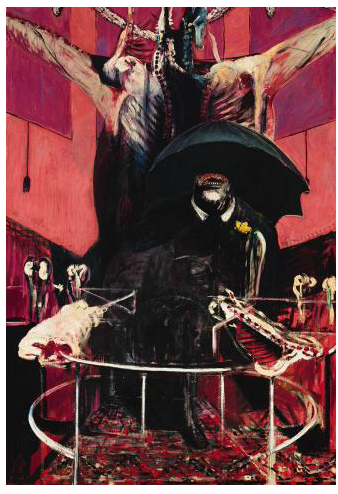
- “Painting”
-
- Who is the artist?
- Which event does this respond to and what statement does it make?
- What may have inspired the image of the male figure?
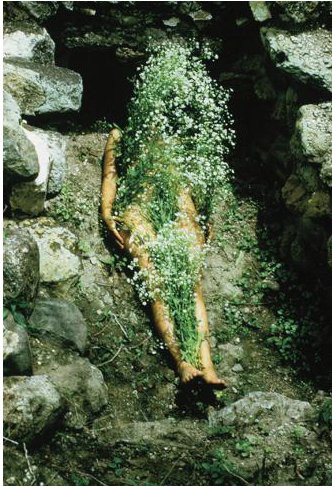
- “Flowers on Body”
-
- What issues did this artist address in her work?
- What series does this particular image belong to?
- What themes does this image address?
- “Backs”
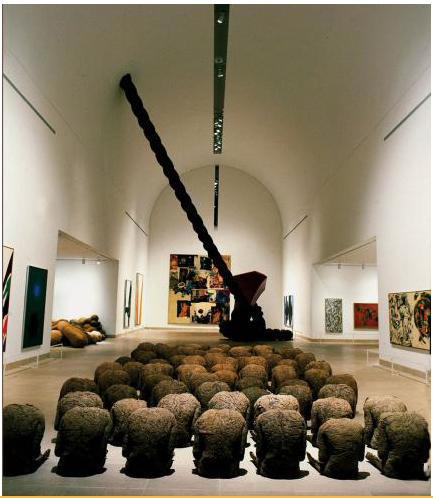
- What materials did the artist use in her works?
- How is this representative of her work?
- What do the forms suggest in this work?
Our website has a team of professional writers who can help you write any of your homework. They will write your papers from scratch. We also have a team of editors just to make sure all papers are of HIGH QUALITY & PLAGIARISM FREE. To make an Order you only need to click Ask A Question and we will direct you to our Order Page at WriteDemy. Then fill Our Order Form with all your assignment instructions. Select your deadline and pay for your paper. You will get it few hours before your set deadline.
Fill in all the assignment paper details that are required in the order form with the standard information being the page count, deadline, academic level and type of paper. It is advisable to have this information at hand so that you can quickly fill in the necessary information needed in the form for the essay writer to be immediately assigned to your writing project. Make payment for the custom essay order to enable us to assign a suitable writer to your order. Payments are made through Paypal on a secured billing page. Finally, sit back and relax.
About Writedemy
We are a professional paper writing website. If you have searched a question and bumped into our website just know you are in the right place to get help in your coursework. We offer HIGH QUALITY & PLAGIARISM FREE Papers.
How It Works
To make an Order you only need to click on “Place Order” and we will direct you to our Order Page. Fill Our Order Form with all your assignment instructions. Select your deadline and pay for your paper. You will get it few hours before your set deadline.
Are there Discounts?
All new clients are eligible for 20% off in their first Order. Our payment method is safe and secure.