

Question Description
NOTE: The x-axis of the Blackbody spectra should read "Frequency", not "Wavelength" (and pay attention to the "ROYGBIV" labels).

For questions 1-4, refer to the picture above. We're talking luminosity at a star's surface (which is, by default, what astronomers assume when they are dealing luminosity, unless otherwise stated).
1. Which star has the greatest luminosity: A, B, the same luminosity, or insufficient information? Which star has the greatest flux: A or B, the same flux, or insufficient information? In each case, explain why.
2. Which star has the greatest luminosity: C, D, the same luminosity, or insufficient information? Which star has the greatest flux: C or D, the same flux, or insufficient information? In each case, explain why.
3. Which star has the greatest luminosity: E, F, the same luminosity, or insufficient information? Which star has the greatest flux: E or F, the same flux, or insufficient information? In each case, explain why.
4. Which star has the greatest luminosity: G, H, the same luminosity, or insufficient information? Which star has the greatest flux: G or H, the same flux, or insufficient information? In each case, explain why.
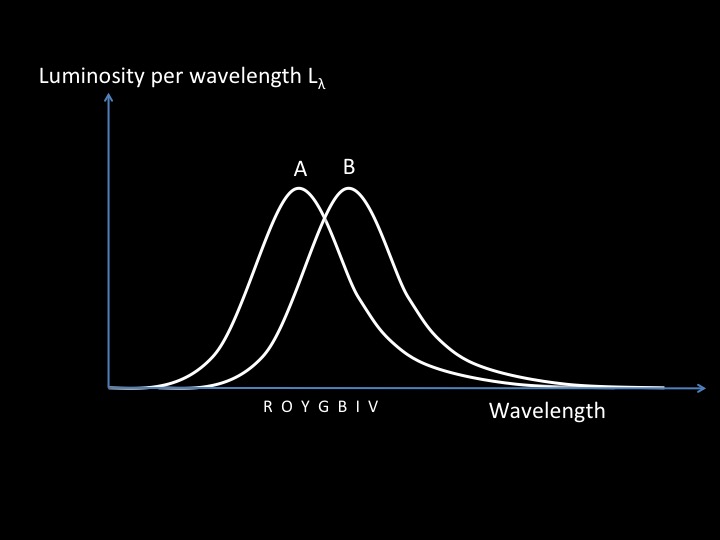
5. Refer to the Blackbody spectra above.
(a) What colors might stars A and B look to the naked eye?
(b) Which has the highest temperature, A, B, the same temperature, or insufficient information? How can you tell?
(c) Which has the highest luminosity, A, B, the same luminosity, or insufficient information? How can you tell?
(d) Which star is the largest, A, B, the same size, or insufficient information? How can you tell?

6. Refer to the Blackbody spectra above.
(a) Which has the highest temperature, C, D, the same temperature, or insufficient information? How can you tell?
(b) Which has the highest luminosity, C, D, the same luminosity, or insufficient information? How can you tell?
(c) Which star is the largest, C, D, the same size, or insufficient information? How can you tell?
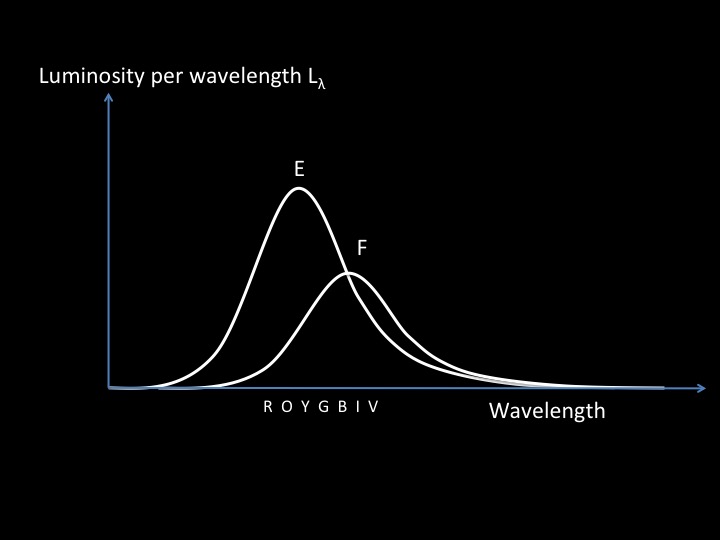
7. Refer to the Blackbody spectra above. (ETA: use the ROYGBIV ordering as your guide – in other words, assume wavelength is decreasing from left to right.)
(a) Which has the highest temperature, E, F, the same temperature, or insufficient information? How can you tell?
(b) Which has the highest luminosity, E, F, the same luminosity, or insufficient information? How can you tell?
(c) Which star is the largest, E, F, the same size, or insufficient information? How can you tell?
8. Here's an example of some calculations an astronomer might do: your goal is to select 3 stars at random from the Hipparcos catalog, and estimate their temperature and radius. The procedure is outlined below, and you will need the following pieces of information: the absolute visual magnitude of the Sun is MV=4.83, and the surface temperature of the Sun is 5,778 K.
(a) Pick any 3 stars from the catalog of stars whose parallaxes were measured by Hipparcos, (they can be the same as the ones you chose last week). Read off their parallaxes, their apparent visual magnitude mV, and their B-V color index. (From the link, scroll down and select, in addition to the options that are already checked, the "vmag (mag)" and "bv_color" options. The scroll right to the bottom of the page, and click on "Start Search": this will take you to the catalog.)
(b) Use the parallax to calculate the distance to the star in parsecs, D(pc).
(c) Use D(pc) and the apparent visual magnitude to calculate the absolute visual magnitude of the star (using the distance modulus formula).
(d) Use the absolute visual magnitude of the star and the absolute visual magnitude of the Sun to calculate the luminosity of the star in terms of the solar luminosity (n.b. you don't need to convert it into units of Watts)
(e) Use the color index B-V to estimate the surface temperature of the star using the empirical formula below. This gives the temperature in Kelvin; write it also in terms of solar surface temperature (i.e. how many times the Sun's surface temperature is it?).

(f) Use the formula below to estimate the radius of the star in terms of the Sun's radius.

(g) Check your answer makes sense.
Our website has a team of professional writers who can help you write any of your homework. They will write your papers from scratch. We also have a team of editors just to make sure all papers are of HIGH QUALITY & PLAGIARISM FREE. To make an Order you only need to click Ask A Question and we will direct you to our Order Page at WriteDemy. Then fill Our Order Form with all your assignment instructions. Select your deadline and pay for your paper. You will get it few hours before your set deadline.
Fill in all the assignment paper details that are required in the order form with the standard information being the page count, deadline, academic level and type of paper. It is advisable to have this information at hand so that you can quickly fill in the necessary information needed in the form for the essay writer to be immediately assigned to your writing project. Make payment for the custom essay order to enable us to assign a suitable writer to your order. Payments are made through Paypal on a secured billing page. Finally, sit back and relax.
About Writedemy
We are a professional paper writing website. If you have searched a question and bumped into our website just know you are in the right place to get help in your coursework. We offer HIGH QUALITY & PLAGIARISM FREE Papers.
How It Works
To make an Order you only need to click on “Place Order” and we will direct you to our Order Page. Fill Our Order Form with all your assignment instructions. Select your deadline and pay for your paper. You will get it few hours before your set deadline.
Are there Discounts?
All new clients are eligible for 20% off in their first Order. Our payment method is safe and secure.